| Year | Title | Author | Pages |
|---|---|---|---|
| 1270 | Njal's Saga | Anonymous | 384 |
| 1605 | Don Quixote | 1072 | |
| 1719 | Robinson Crusoe | Daniel Defoe | 286 |
| 1845 | Narrative of the Life of Frederick Douglass, an American Slave | Frederick Douglass | 224 |
| 1910 | Howards End | E. M. Forster | 302 |
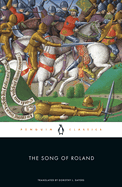
| The Song of Roland | 208 | ||
| Selected Poems | Rumi | 310 | |
| Little Women | Louisa May Alcott | 544 |
Daniel Defoe (c. 1660 - 1731) was an English writer, journalist, and spy, who gained enduring fame for his novel, Robinson Crusoe. Defoe is notable for being one of the earliest practitioners of the novel and helped popularize the genre in Britain. In some texts he is even referred to as one of the founders, if not the founder, of the English novel. A prolific and versatile writer, he wrote more than five hundred books, pamphlets, and journals on various topics (including politics, crime, religion, marriage, psychology and the supernatural). He was also a pioneer of economic journalism.
Louisa May Alcott, born in 1832, was the second child of Bronson Alcott of Concord, Massachusetts, a self-taught philosopher, school reformer, and utopian who was much too immersed in the world of ideas to ever succeed in supporting his family. That task fell to his wife and later to his enterprising daughter Louisa May. While her father lectured, wrote, and conversed with such famous friends as Emerson, Hawthorne, and Thoreau, Louisa taught school, worked as a seamstress and nurse, took in laundry, and even hired herself out as a domestic servant at age nineteen. The small sums she earned often kept the family from complete destitution, but it was through her writing that she finally brought them financial independence. “I will make a battering-ram of my head,” she wrote in her journal, “and make a way through this rough-and-tumble world.”