
Sale price
$1799
The Gravity Tree
Ages 4–8 · 2021
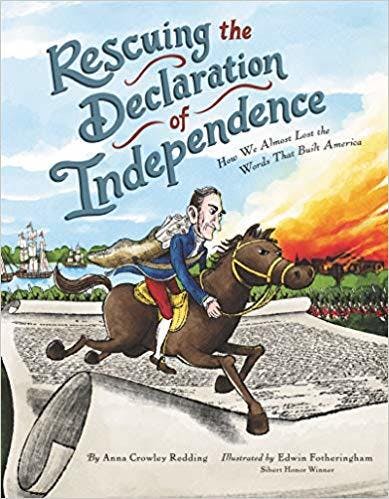
Written by Anna Crowley Redding · Illustrated by Edwin Fotheringham
A clerk races to save America's founding documents from destruction during the War of 1812.
In the chaos of the War of 1812, clerk Stephen Pleasonton faces an urgent mission: save the Declaration of Independence and the Constitution from the advancing British army. As Washington teeters on the brink of disaster, Stephen's quiet life is upended, thrusting him into a race against time. Can this unassuming clerk protect the nation's most treasured documents from obliteration? Discover the forgotten heroism that preserved America's founding words in this gripping historical adventure.
"If Stephen wanted to remember why America declared herself the land of the free, all he had to do was look up from his work. The original Declaration of Independence hung on the wall."
— from the book
He saved the words that built America! Emmy Award–winning journalist Anna Crowley Redding and Sibert Honor illustrator Edwin Fotheringham bring to life the riveting true story about the lowly clerk who saved the Declaration of Independence from being destroyed by the British army in the War of 1812.
“We hold these truths to be self-evident, that all men are created equal, that they are endowed by their Creator with certain unalienable Rights, that among these are Life, Liberty and the pursuit of Happiness.”
These are the words that helped found our nation. Today the Declaration of Independence is one of the United States’ most heavily guarded treasures, but during the War of 1812 it would have been destroyed if not for one man whose story has nearly been forgotten by time. Come along on this historic adventure and learn how one ordinary clerk did a truly extraordinary thing.
As a clerk for the State Department, Stephen Pleasonton spent his days quietly immersed in paperwork. He never expected to receive an urgent message telling him that the British army was on its way to the capital. And that the documents that Stephen was entrusted with—such as the original Declaration of Independence and the original Constitution—were all in danger!
It fell on Stephen to get our nation’s most cherished and priceless artifacts safely out of Washington!
It’s 1814, and Stephen Pleasanton serves as a clerk for Secretary of State James Monroe, which primarily means “Stephen lived and breathed paper.” When, on a scouting expedition during the War of 1812, Secretary Monroe discovers the British plan to march on America’s newly established capital, Washington, D.C., he sends urgent news to Pleasanton to “Remove the records.” Thus begins Pleasanton’s urgent task of transporting the founding documents of the young nation, including the Constitution and the Declaration of Independence, to a safe location outside the capital. This undertaking requires securing any wagons available and carting load after load of linen sacks stuffed full of rolled parchment. It also requires defying the most powerful military leader in the country, Secretary of War John Armstrong, who is convinced the British won’t attack the capital. As Pleasonton recovers in a tavern room once all the documents are safely hidden, Washington can be seen out the window, alight in orange and yellow flames. Some commentary by Redding and the inclusion of details bordering on minutiae make this story about an unknown but interesting piece of history about America’s founding documents a little long, but overall Redding’s storytelling is engaging and easy to read. Fotheringham’s (A Home for Mr. Emerson) busy illustrations match the urgency of Pleasonton’s rescue mission and even include instances of hand lettering that add a historic, substantive feel to the story otherwise cheapened by his cartoonish caricatures with their oversized heads and exaggerated features.
“The detailed—to a fault, at times—story of an ordinary clerk that saved America’s extraordinary documents. ”
Bookroo Editorial
Reviewed January 2020
To save the Declaration of Independence and other important documents, Stephen had to stand up to leaders. Have you ever had someone question what you believed or said? How did you respond?
The first place where the documents were hidden, the gristmill, was not a safe place. Stephen made the difficult but important decision to move them again. Have you ever had to redo a project, even when it seemed very hard to do it again?
4.4
out of 7


Surprise a reader with their next favorite book.
Spotted a mistake or something missing? Improve this page.
Are you the author or illustrator? Claim your book.
Top contributors: Laura Renauld