
Sale price
$1899
Gertie
Ages 6–9 · 2023
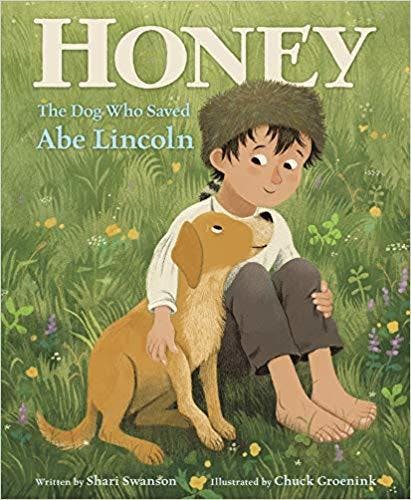
Written by Shari Swanson · Illustrated by Chuck Groenink
A young Abe Lincoln's life is saved by a stray dog he once rescued.
In Knob Creek, Kentucky, young Abe Lincoln befriends a stray dog with a broken leg, naming him Honey. As Abe roams the countryside, freeing trapped animals, he forms an unbreakable bond with Honey. But when danger strikes, it's Honey who becomes the hero, saving Abe's life. This heartwarming tale reveals a little-known chapter of Lincoln's childhood, where friendship and bravery intertwine in a life-changing rescue.
“I just can’t move along fast like some boys . . . I see so many little foolish things that make me stop. I can’t help it to save my life.”
— from the book
Based on a little-known tale from Abraham Lincoln’s childhood, this charming picture book written by debut author Shari Swanson and illustrated by acclaimed artist Chuck Groenink tells a classic story of a boy, his dog, and a daring rescue.
Deeply researched and charmingly told, this is the true story of one extra-special childhood rescue—a dog named Honey.
Long before Abraham Lincoln led the nation or signed the Emancipation Proclamation, he was just a barefoot kid running around Knob Creek, Kentucky, setting animals free from traps and snatching frogs out of the jaws of snakes.
One day, young Abe found a stray dog with a broken leg and named him Honey. He had no idea that the scruffy pup would find his way into Abe’s heart, become his best friend, and—one fateful day—save his life.
As the thorough timeline and endnotes explain, Abraham Lincoln believed that “[e]ven an ant values its life,” and Lincoln cherished animals his whole life, from his backwoods cabin in Kentucky all the way to the White House. When as an adventurous and free spirited boy Lincoln discovers Honey the dog with a broken leg in the woods, the resourceful young woodsman uses a stick and “the soft bark off a pawpaw bush” to set the dog’s leg with a splint. He insists to his mother, who is unsurprised to see her son arrive at the door late and with another stray animal, that he believes that Honey will “do lots of good things” for him. And when the (perhaps too) free-spirited Lincoln again ventures off, this time, without having informed anyone of where he was going, wandering deeper and deeper into a cave until he is eventually trapped behind a boulder, his prophecy proves true as Honey is able to lead villagers to him, and he is ultimately rescued. A valuable contribution to children’s literature detailing various parts of the sixteenth president’s life, this story is particularly unique as it’s based on an oral history of Lincoln shared by his childhood friend, Austin Gollaher. Groenink presents the story in digital illustrations that are simple and match the tone of a young Lincoln.
“The story of Honey the dog provides a focused anecdote to introduce readers to Abraham Lincoln’s lifelong love and respectful treatment of animals.”
Bookroo Editorial
Reviewed January 2020
Abraham Lincoln is an adventurous young boy, but his exploring causes him to get stuck in a cave without anyone besides his dog, Honey, knowing where he is. While happily he is saved, what lessons about safety in the outdoors can be learned from his experience?
Lincoln loved and was very kind to animals throughout his life. He even kept many animals at the White House when he was president. What is your favorite kind of animal, and why?
4.5
out of 7
“Swanson’s story reads aloud well. Groenink’s appealing digital illustrations portray young Abe and Honey within idyllic Kentucky landscapes and haunting, torch-lit cavern scenes. An enjoyable, Lincoln-themed picture book.”
Critic
“The well-paced text includes invented dialogue attributed to Abe . . . This story focuses on . . . Abe’s rescue; a more complete look at Lincoln’s life is included in an appended timeline . . . which include[s] references to Lincoln’s kindness to animals . . . "This heartwarming story of a boy and his beloved dog opens the door for further study of our 16th president.”
Critic


Surprise a reader with their next favorite book.
Spotted a mistake or something missing? Improve this page.
Are you the author or illustrator? Claim your book.