
Sale price
$1895
Buffalo Wild!
Ages 4–7 · 2021
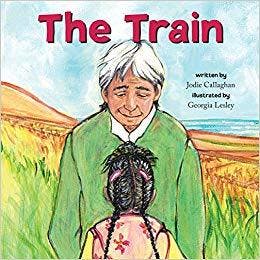
Written by Jodie Callaghan · Illustrated by Georgia Lesley
A train once took children away, changing lives forever. Can hope and remembrance bring healing to a community's past?
Ashley discovers her great-uncle's sorrow by the old train tracks in Nova Scotia. He reveals a haunting past when children, including himself, were taken to a residential school, forbidden from speaking Mi'gmaq, and deprived of love. As they sit together, Ashley promises to remember and wait with him, hoping for healing and the return of what was lost. Will their bond and shared memories bring solace to a community scarred by history?
Ashley meets her great-uncle by the old train tracks near their reserve in Nova Scotia. When she sees his sadness, he shares with her the history of those tracks. Uncle tells her that, during his childhood, the train would bring their community supplies, but there came a day when the train took away with it something much more important. One day he and the other children from the reserve were taken aboard and transported to a residential school, where their lives were changed forever. Ashley promises to wait with her uncle as he sits by the tracks, waiting for what was taken from their people to come back to them.
As a young girl walks home from school through the Canadian countryside, she happens upon her uncle, who is standing at the site of a demolished train station. When she asks what he is doing, he answers that he is waiting for the train. Seeing the tracks in disrepair and knowing the line to be abandoned, the girl is confused, but as they sit together, the uncle relates the tragic history of how he, along with siblings and over 150,000 Indigenous children in Canada, were forced to leave their homes and attend residential schools, where their heritage and culture were repressed. Now he waits for “what we lost that day to come back to us.” Lesley’s illustrations flow between semi abstract and realism, matching Callaghan’s somber story of a reality shaped by a tragic but almost forgotten past. The inclusion of details such as the uncle eating a raw potato make the story very personal and believable. The narration is rough at moments—why does the light in Uncle’s eyes counter an otherwise cheerful expression coming over his face?—and presents a time of historical mistreatment in a tone that would leave readers with a sense of hopelessness but for the girl’s willingness to join her uncle in waiting for better days to return.
“An educational and somber tale of mistreatment suffered by Indigenous children in Canada. ”
Bookroo Editorial
Reviewed February 2020
4.5
out of 7


Surprise a reader with their next favorite book.
Spotted a mistake or something missing? Improve this page.
Are you the author or illustrator? Claim your book.