
Sale price
$1999
The Princess and the Warrior
Ages 6–9 · 2016
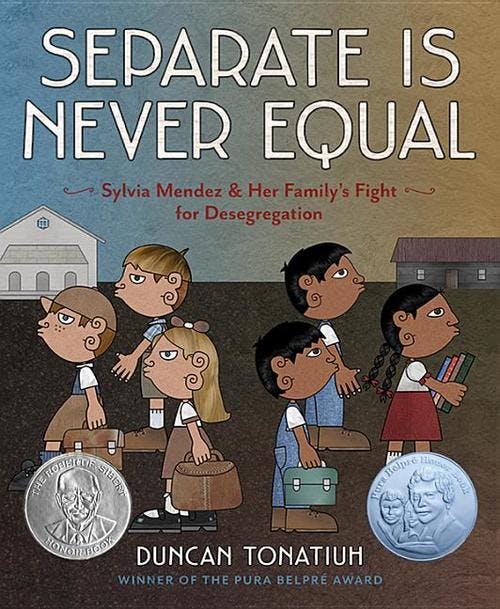
Written by Duncan Tonatiuh
A family challenges school segregation, changing history.
In 1946 California, young Sylvia Mendez faces rejection from a 'Whites only' school despite being an American citizen. Her family's fight against this injustice sparks a pivotal legal battle, Mendez v. Westminster, that ends school segregation in California, paving the way for future civil rights victories. Will their courage inspire change across the nation?
A 2015 Pura Belpré Illustrator Honor Book and a 2015 Robert F. Sibert Honor Book
Almost 10 years before Brown vs. Board of Education, Sylvia Mendez and her parents helped end school segregation in California. An American citizen of Mexican and Puerto Rican heritage who spoke and wrote perfect English, Mendez was denied enrollment to a “Whites only” school. Her parents took action by organizing the Hispanic community and filing a lawsuit in federal district court. Their success eventually brought an end to the era of segregated education in California.
Praise for Separate is Never Equal
STARRED REVIEWS
“_Tonatiuh masterfully combines text and folk-inspired art to add an important piece to the mosaic of U.S. civil rights history.”
–_Kirkus Reviews, starred review
“Younger children will be outraged by the injustice of the Mendez family story but pleased by its successful resolution. Older children will understand the importance of the 1947 ruling that desegregated California schools, paving the way for Brown v. Board of Education seven years later.”
–School Library Journal, starred review
“Tonatiuh (Pancho Rabbit and the Coyote) offers an illuminating account of a family’s hard-fought legal battle to desegregate California schools in the years before Brown v. Board of Education.”
–Publishers Weekly
“Pura Belpré Award-winning Tonatiuh makes excellent use of picture-book storytelling to bring attention to the 1947 California ruling against public-school segregation.”
–Booklist
“The straightforward narrative is well matched with the illustrations in Tonatiuh’s signature style, their two-dimensional perspective reminiscent of the Mixtec codex but collaged with paper, wood, cloth, brick, and (Photoshopped) hair to provide textural variation. This story deserves to be more widely known, and now, thanks to this book, it will be.”
–The Horn Book Magazine


Surprise a reader with their next favorite book.
Spotted a mistake or something missing? Improve this page.
Are you the author or illustrator? Claim your book.
Top contributors: B is for Bookworm