Gravity
Let go of anything and it falls. Take gravity away and the whole page drifts off into space.
Gravity is the first law of physics every baby tests, usually from a high chair, usually with a spoon. Children keep running the experiment for years afterward — off the couch, down the slide, over the handlebars — long after they have stopped calling it an experiment. What makes it such good material for a book is that the everyday version and the cosmic version are the same force: whatever pulls a dropped crayon to the rug is what holds the Moon in its orbit, and nobody, physicists included, can tell you exactly what it is. That is a rare thing to be able to say honestly to a six-year-old.
From Bookroo’s collection of gravity books, our editors chose twelve that cover the whole arc — what gravity does, how to test it on the kitchen floor, the apple tree that started the explaining, and why astronauts float. Start with the shortlist, then browse sturdy first science for toddlers, read-alouds and experiment books for the picture-book years, and guides for readers ready for Newton’s laws with the real vocabulary attached.
Let go of anything and it falls. Take gravity away and the whole page drifts off into space.
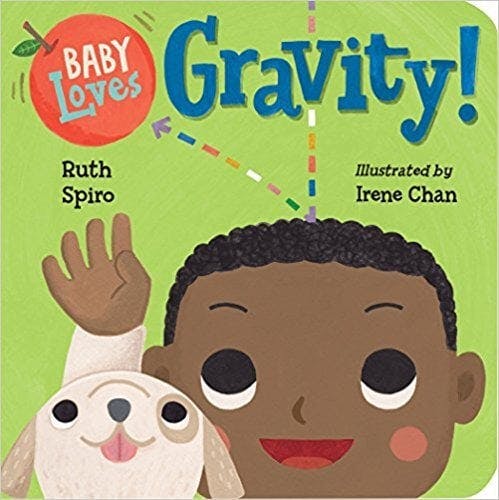
The food goes off the high chair tray. Something pulls it down. That something has a name.
Drop a shoe and a sock at the same moment and find out which one wins.
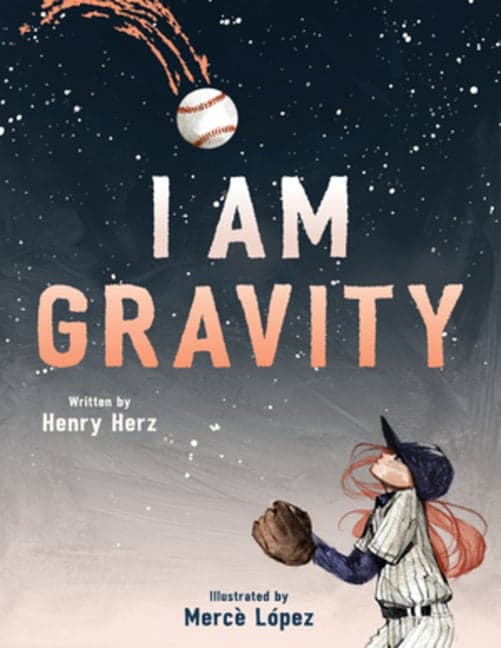
Told in gravity’s own voice: I pull the tides, I hold the stars, I brought the apple down.
Leda trips, drops, spills, and tumbles all day, and decides gravity is out to get her personally.
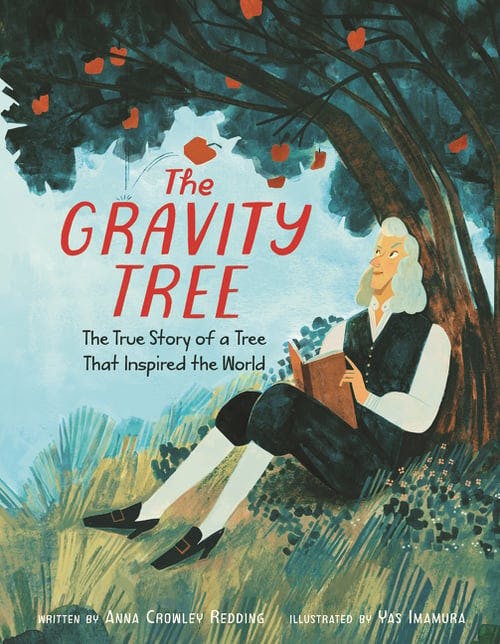
The apple tree at Newton’s farmhouse is still standing, and pieces of it have been to space.
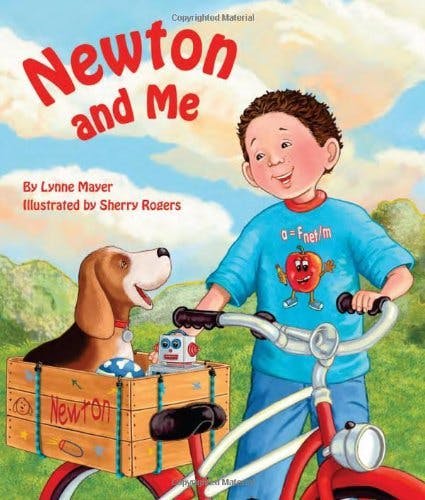
A boy and his dog, Newton, find force and motion in a ball game, a bike ride, and a wagon.
Why the ball leaves the table, and what happened when an astronaut dropped a hammer and a feather on the Moon.
Gravity, inertia, and relativity drawn as characters, each introducing itself in a page.
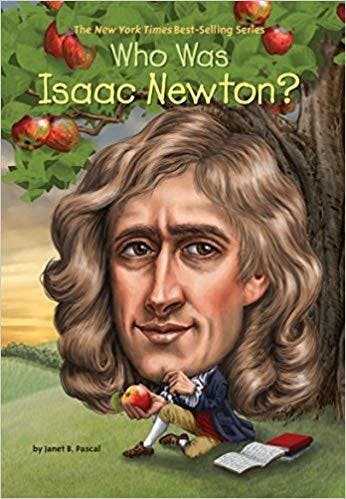
Sent home from Cambridge by the plague, a difficult young man works out the laws that run the sky.
Pierce a balloon without popping it, then find out which seat on a roller coaster is the best one.
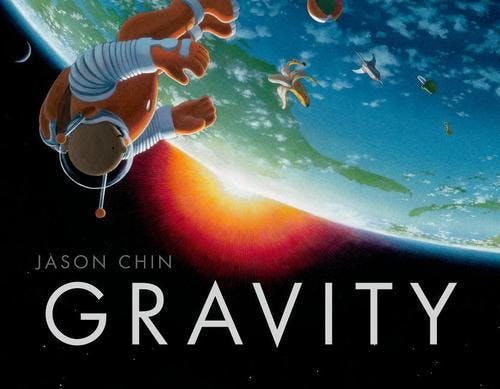
What actually happens to a body with no weight — including the parts nobody puts in the brochure.
Why the spoon lands on the floor — first physics in sturdy pages, using the real words instead of a baby substitute for them. Ages 0–5.
Introduce your baby to Newton's laws of motion with playful simplicity.
Explore physics from A to Z in a colorful, simple way.
Introduce your baby to Einstein's theory with simple concepts of spacetime and black holes.
Read-alouds, classroom explainers, and drop-it-yourself activity books about falling, weight, and the invisible pull. Ages 3–9.
Eating in space is tricky—no gravity, no crumbs, no mess!
Explore life on a space station through interactive pages revealing astronauts' daily routines.
Ignoring a warning, a boy's bed crashes through floors, leading to unexpected adventures.
Embark on a lunar journey and discover how to return home safely.
A cloudy night leads to a magical lunar adventure on the bus.
Bird builds a nest using push and pull. What's it waiting for?
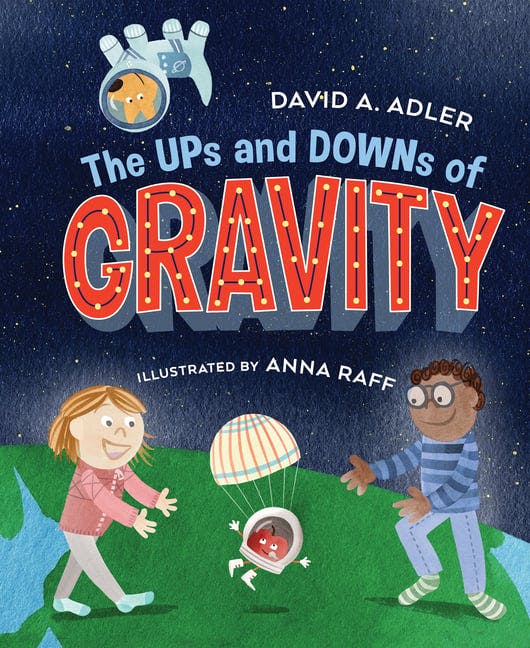
What goes up must come down — but nobody can say exactly what gravity is.
Discover the genius and contradictions of Isaac Newton amid 17th-century turmoil.
A curious boy's questions lead to groundbreaking discoveries in science.
Two friends defy gravity to stay together against all odds.
Uncover hidden forces with outdoor experiments.
Newton’s laws, hands-on physics, orbits, rockets, and life without weight, for readers ready for the real terms. Ages 6–11.
Explore 2,000 years of rocket history and their future impact.
Discover the science of forces and motion through thrilling adventures.
Uncover the mysteries of our universe's origins and celestial wonders.
Explore the forces of nature with Max Axiom's thrilling science adventure.