How do I set daily page goals for a student?
Step by step · Updated
Set daily page goals in a reading conference: agree with the student on how many pages a day fits the book they're reading, then save it as a reading plan in their panel. Bookroo works out the page to reach on each reading day, and the student sees today's page on their book card, ready to mark in the book with a sticky note.
Set a plan in a reading conference
- On your class Home, click the student's tile, or open Status of the Class and click their name. Their panel opens.
- Ask what page they're on. Under Reading now, type it next to Now on p. and press Enter, so the plan starts from the right place.
- Find a number of pages a day together. A quick way is to have the student read for five minutes in this book and count the pages, then scale it to the time they'll read each day: 4 pages in 5 minutes is 16 pages in 20 minutes. Talk about why the goal fits, and check that it sounds doable to them.
- Under the book, click + Set a reading plan. Enter the Pages a day, then click the Days they read (Monday to Friday are already picked; add the weekend if they'll read then).
- Look over the page it lists for each reading day, starting from today, and click Save.
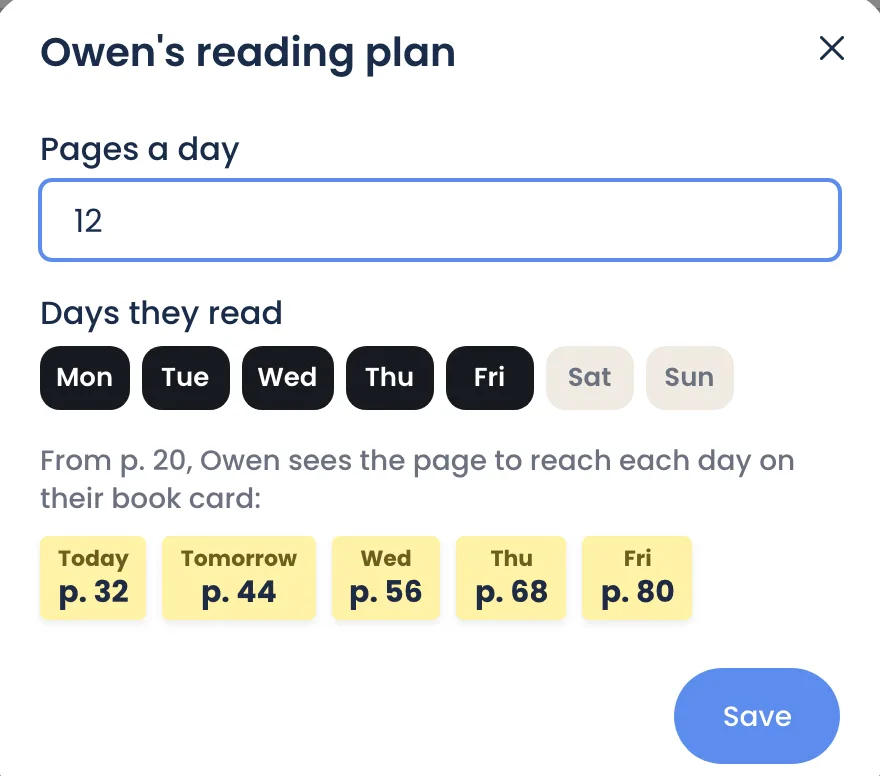
- Have the student write each day's page on a sticky note and put it in the book on that page. If a page lands just short of the end of a chapter, moving the note there is fine.
The panel then shows the plan under the book, such as 12 pages a day, Mon–Fri · today p. 32. A plan doesn't change points, goals or the notes on Status of the Class.
What the student sees
On their dashboard, the card beside the book they're reading in their Reading Journey shows today's page, such as Today → p. 32. When they save a page that reaches it, the card says Today's page! and shows the next one.
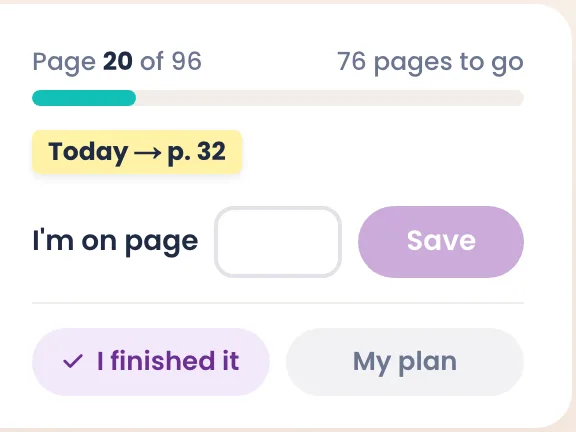
Clicking My plan lists the next few days' pages, to copy onto sticky notes. Students can't change the plan. On a book with no update in 2 weeks, I stopped takes the place of My plan, and today's page still shows.

Change or end a plan
- Change it: in the student's panel, click the plan under the book, change the pages a day or the days, and click Save. The plan starts again from the page they're on today, so a student who fell behind gets a fresh start rather than a pile of missed pages.
- End it: click the plan, then Remove the plan.
- A new book needs a new plan. A plan belongs to one book. When the student finishes it or starts another, set one for the new book in your next conference. A student has one plan at a time in your class.
Why daily page goals work
Daily page goals turn independent reading into small, visible steps, which is what the research on goal setting supports:
- A goal for today works better than a goal for the whole book. In a classic study, children aiming to finish at least six pages of their workbook each session got through more of it (74% of the material, against 55% for a whole-booklet goal and 53% with no goal), built more skill and confidence, and did more of that work when given a free choice of activities (Bandura & Schunk, 1981).
- A specific number gives students more to aim for than "read as much as you can" (Locke & Latham, 2002).
- Set it together, and say why. Students commit more to goals they help set (Schunk, 1985), and a goal the teacher sets works as well when its purpose is explained (Locke & Latham, 2002). The IES practice guide on adolescent literacy makes the same point: students who set their own goals are "more apt to be fully engaged" (Kamil et al., 2008). That's why the number is agreed in the conference, and you save it.
- Seeing progress builds confidence. The IES practice guide for K–3 reading comprehension recommends setting goals with students, monitoring their progress toward them and giving frequent positive feedback (Shanahan et al., 2010). Sticky notes in the book and Today's page! on the card make progress easy to see.
- Choosing the days and marking the stopping page helps students follow through. Plans that say when and where tend to be kept more often than goals alone, though most of that research is with adults (Gollwitzer & Sheeran, 2006).
- Students who read more tend to read better (Anderson, Wilson & Fielding, 1988). That finding is a correlation: a plan helps a student keep going and finish books, but no study shows that page goals on their own raise reading scores.
Fit the goal to the book
The right number of pages depends on the book as much as the reader. A page of Harry Potter and the Sorcerer's Stone holds about 245 words; a page of a novel in verse like The Crossover holds about 70. Twenty minutes of reading could be around 13 pages of one and 45 of the other. Reading speed also varies about twofold among students in the same grade (Hasbrouck & Tindal, 2017; Spichtig et al., 2016). A short timed read in the student's own book measures both at once, which no pages-per-minute rule can, especially for graphic novels.
Set a new plan when a student changes books, and adjust the number at your next conference if it turns out too easy or too hard.
Keep it a goal, not a log
Students see a plan as something to aim for, not something to report on. In one study, requiring 2nd and 3rd graders to log 20 minutes a night with a parent's signature lowered their interest in reading, while making it voluntary raised it (Pak & Weseley, 2012). So a plan asks for no minutes, no signatures and no check-off: the student saves their page as usual, and the sticky note tells them how far to go. Celebrate the days they reach it, and treat a missed day as a reason for a conversation.
Research
- Anderson, R. C., Wilson, P. T., & Fielding, L. G. (1988). Growth in reading and how children spend their time outside of school. Reading Research Quarterly, 23(3), 285–303.
- Bandura, A., & Schunk, D. H. (1981). Cultivating competence, self-efficacy, and intrinsic interest through proximal self-motivation. Journal of Personality and Social Psychology, 41(3), 586–598.
- Gollwitzer, P. M., & Sheeran, P. (2006). Implementation intentions and goal achievement: A meta-analysis of effects and processes. Advances in Experimental Social Psychology, 38, 69–119.
- Hasbrouck, J., & Tindal, G. (2017). An update to compiled ORF norms (Technical Report No. 1702). Behavioral Research and Teaching, University of Oregon.
- Kamil, M. L., et al. (2008). Improving adolescent literacy: Effective classroom and intervention practices (NCEE 2008-4027). Institute of Education Sciences.
- Locke, E. A., & Latham, G. P. (2002). Building a practically useful theory of goal setting and task motivation. American Psychologist, 57(9), 705–717.
- Pak, S. S., & Weseley, A. J. (2012). The effect of mandatory reading logs on children's motivation to read. Journal of Research in Education, 22(1), 251–265.
- Schunk, D. H. (1985). Participation in goal setting: Effects on self-efficacy and skills of learning-disabled children. Journal of Special Education, 19(3), 307–317.
- Shanahan, T., et al. (2010). Improving reading comprehension in kindergarten through 3rd grade (NCEE 2010-4038). Institute of Education Sciences.
- Spichtig, A. N., et al. (2016). The decline of comprehension-based silent reading efficiency in the United States. Reading Research Quarterly, 51(2), 239–259.
Still stuck?
Email us or book a call. A person on the Bookroo team will help.